A 21st Century Guide to Chain-Reaction Disciple-Making in the West
Based on a conversation with Cory Hartman from New Generations on the 1000 Houses Podcast. View the original video here.
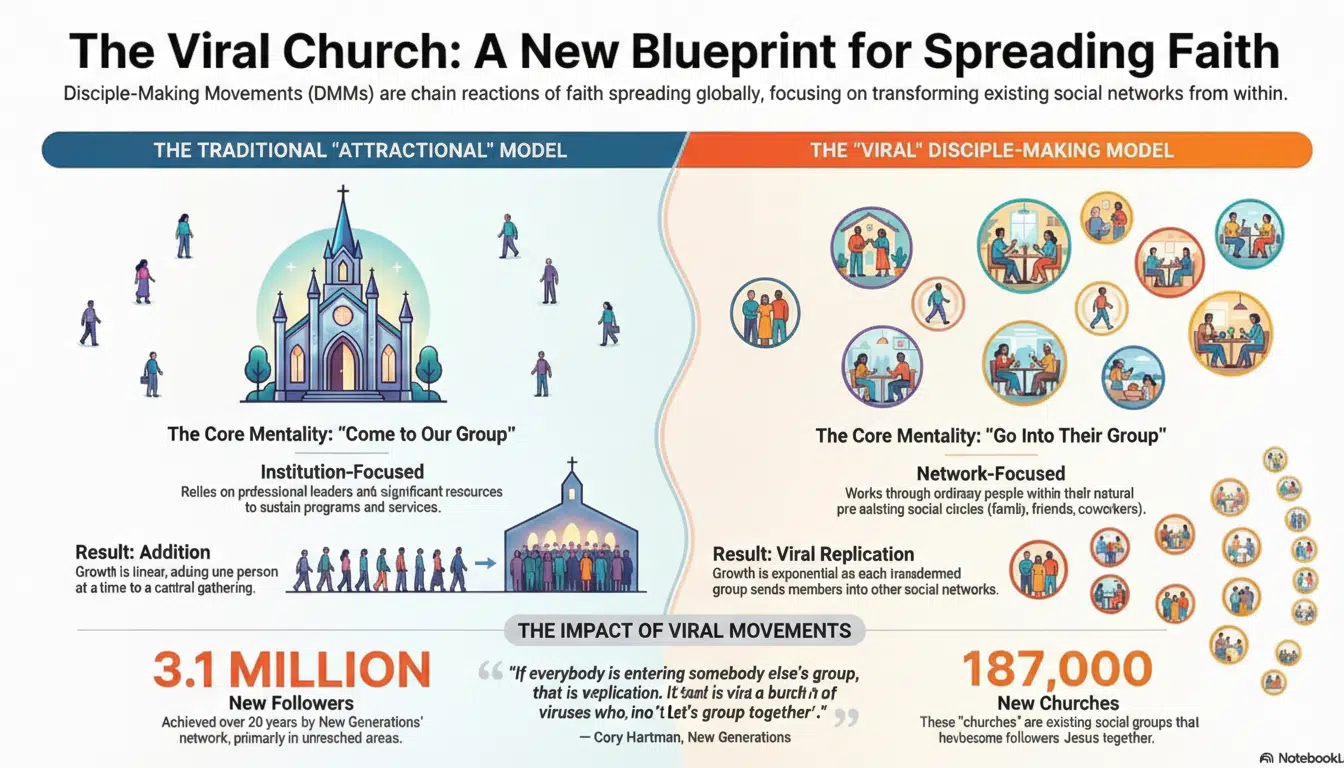
In a world where traditional church models often struggle to create lasting disciples, there's a growing movement seeing extraordinary results. Over the past 20 years, one network has witnessed 3.1 million new followers of Jesus and 160,000 churches planted among some of the least reached people groups in the world. But what can we learn from these movements for disciple-making in Western contexts?
The Challenge: Distinguishing Church from Ekklesia
One of the most profound insights from disciple-making movements is the distinction between "church" as we know it institutionally and "ekklesia" as described in Scripture. As Cory Hartman from New Generations explains:
"There's this word church that's an English word that has been around for many centuries... and then there's this word in the scriptures, ekklesia... The problem is that the English word church very genuinely carries a whole lot of meaning based on how it's been used by English speakers for 800+ years. And all that meaning was not in the heads of the people using the word ekklesia in the first century."
This distinction reveals that many pastors are actually doing two jobs simultaneously:
- Leading a legitimate ekklesia: A gathering of Jesus followers doing "Jesus things."
- Managing a religious institution: Navigating 21st-century expectations and institutional parameters.
Understanding this difference is crucial for anyone serious about fostering a disciple-making movement.
What Makes a Disciple-Making Movement?
A true disciple-making movement (DMM) has three essential characteristics:
1. It's a Chain Reaction
Like fire spreading through a log, a disciple-making movement creates a self-sustaining chain reaction. Each "spark" creates the conditions for the next one, spreading organically through communities.
2. It Runs Through Ordinary People
These movements don't depend on charismatic leaders or exceptional individuals. They spread through people with "average intelligence, average talent, and average leadership ability"—and even those a notch or two below that.
3. It Spreads Through Existing Social Networks
Rather than creating new, artificial groups, the gospel spreads through pre-existing social circles—families, friend groups, work teams, and community connections.
The Oikos Factor: Why First-Century Movements Spread So Rapidly
The early church had a significant advantage: the oikos system. In first-century culture, households (oikos) were the center of religious life, including extended family, servants, and close associates. When the gospel entered an oikos, it could transform entire social units at once.
This explains the "household salvations" seen throughout the Book of Acts—it wasn't just about persecution forcing Christians into homes, but about leveraging the natural spiritual structures that already existed.
Cracking the Code in Western Contexts
The challenge for Western disciple-making is that modern urbanism acts like "an acid bath that breaks apart the bonds of relationships." However, there are three viable approaches to engage these contexts:
- Route 1: Weakened but Existing Social Circles – While not as strong as ancient structures, social circles still exist in book clubs, coffee shop regulars, work teams, and sports leagues. Each has a "center of the circle"—the person whose participation determines whether something happens.
- Route 2: Gathering the Lonely – With epidemic levels of loneliness, many people aren't part of any circle. Sometimes God draws these isolated individuals together to form entirely new communities of disciples.
- Route 3: Leveraging Your Own Circle – You may already be the "person of peace" for your own social network—the one who can introduce the gospel into your existing relationships.
The Viral Principle: Enter, Don't Invite
Perhaps the most counterintuitive insight is this: successful disciple-making movements don't grow by inviting people to your group, but by entering their groups.
As Hartman explains:
"Everything I had ever experienced involved making a group happen... But what I need to do is get adopted into some other group that already exists. And when it starts to catch fire, rather than them do the natural thing—which is to invite more people into their group—say, 'No, no, no, no, no. You go into somebody else's group.' And if everybody is entering somebody else's group, that is viral replication."
This is how viruses actually work—they don't gather together in "virus groups"; they enter existing cellular structures and transform them from within.
Signs of Hope in the West
While fourth-generation movements in Western contexts are still rare, there are encouraging signs:
- Multiple movements in Europe are reaching beyond the fourth generation.
- Several U.S. movements have reached the third generation and are progressing.
- College campuses and recent graduates are showing particular promise.
- The Pacific Northwest has seen exciting developments through networks like Elife.
Moving Forward: The Six-Variable Challenge
Creating a disciple-making movement isn't about adding one new technique to existing ministry. It requires getting multiple variables right simultaneously—it is often an "all or nothing" proposition. But for those willing to fundamentally rethink their approach, the potential for chain-reaction transformation is real.
The question isn't whether disciple-making movements can work in the West, but whether we're willing to let go of our institutional assumptions and embrace the viral nature of the gospel as it spreads through existing relationships.
To learn more about disciple-making movements and access training resources, visit newgenerations.network. For those interested in applying these principles, consider the "Habits of a Multiplying Disciple" course offered periodically by New Generations.
What social circles are you already part of? How might God want to use you to introduce the gospel into existing relationships rather than starting something new?
This post is based on a conversation from the 1000 Houses Podcast. Listen to the full episode for more insights on turning your home into a hub for mission, community, and discipleship.
This means: You are welcome to use it for non-commercial purposes (meaning you are prohibited from reselling it in any way or trying to make money on.) You are prohibited from making derivative works from it (i.e. copy pasting it and passing it off as your own)
If you do share it or redistribute it, you must give attribution by linking to Newgenerations.network